Holliday Family - London to Auckland via Crimea, Bombay and the Taranaki Land Wars
William Holliday was born in London in about 1830. William's British Army records state that on enlistment in 1847 his birthplace is given as St. Georges, Middlesex. William likely appears in the 1841 England and Wales Census as William Holloday, aged 11, living on Wyndham Rd., Camberwell, Surrey. At the time he is living in the Household of his father, Henry (age 60) along with his siblings James (age 20), Sophia (age 15) and George (age 13). On William's marriage registration his father's name is given as Henry, with his occupation being a clerk. The spelling of the surname on the census record as Holloday could be either a later transcription error, or a recording error at the time of the census. The names and ages of William's siblings at the time of the census tie to some extent with christenings recorded at St. Botolph without Aldgate for children of a Henry and Alice Holliday. Without viewing the parish register it will be difficult to push the Holliday family tree back any further than has been done already.
William enlisted as a private in the British Army on the 4'th January 1847. At the time his occupation was given as labourer. The regiment he enlisted in was the 57'th (West Middlesex) Regiment of Foot. At that time the regiment had just returned from spending the years 1830 to 1846 in India. In 1854 the regiment embarked for service in the Crimean War. The regiment fought at the Battle of Inkerman and the Seige of Sevastopol, both of which William took part in, and at some point received a musket wound in the leg. According to his obituary in the Auckland Star of 20 April 1898 William received the Crimea Medal with clasps for Alma, Inkerman and Sebastopol, and the Turkish Medal.
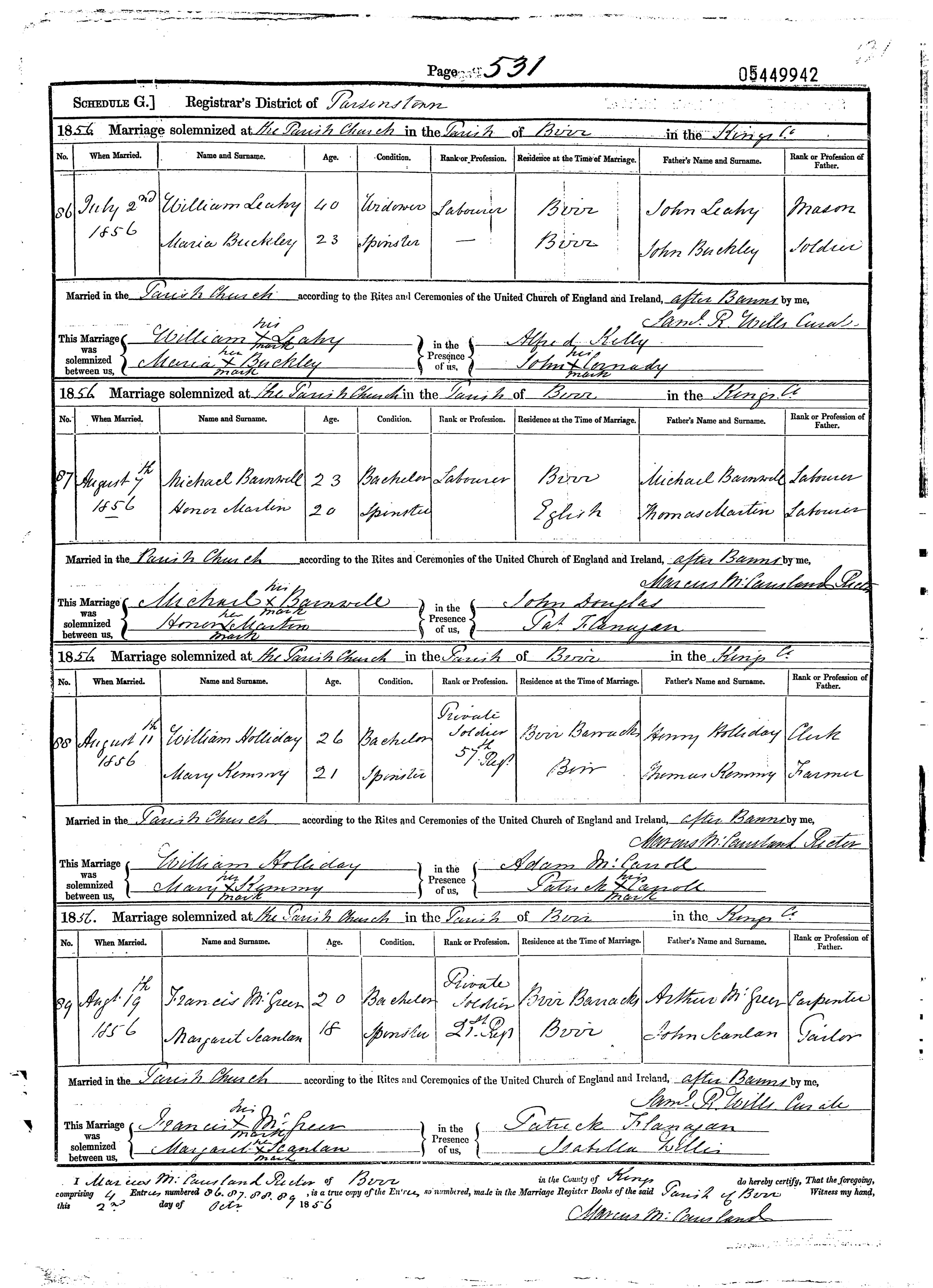
At the conclusion of the Crimean War the 57'th Regiment was sent to Malta. However, there must have been home leave during this period as William married Mary Kemmy on 11 August 1856 at Birr, Ireland. On the marriage registration his occupation is given as a private in the 57'th Regiment stationed at Birr Barracks.
After two years in Malta the 57'th Regiment was dispatched to India in May 1858 to help suppress the Indian Rebellion. During this period the 57'th was headquartered at Pune (called Poona by the British). In November 1860 the 57'th was ordered to Aotearoa to fight in the New Zealand Land Wars. The National Library of Australia has digitised a vast array of material from newspapers to government gazettes to official papers. Among these materials are pay and muster records for all the British Army regiments that served in Australia and Aotearoa during colonial times. These records include the pay and muster records for the 57'th Regiment from October 1860 until they departed Aotearoa in April 1867. William did not leave Poona until march 1861, so it was likely that he was on the steamship Prince Arthur, which brought the last detachment of the 57'th to Aotearoa along with wives and children.
From the middle of 1861 until May of 1864 William was stationed at various redoubts around the Taranaki: New Plymouth, Waitara (late 1861), Bell Blocks (early 1863), Oakura (mid 1863), Poutoko (late 1863). In 1864 part of the 57'th established a base at Whanganui (April 1864) where William was stationed until March 1866. In July 1864 William committed a military offence which led to him losing his good conduct pay and being confined to military prison for 37 days. The good conduct pay was restored in September 1865. In April 1866 the 57'th was posted to Ngāruawāhia, where they remained until March 1867 when they were withdrawn from Aotearoa and returned to the UK. When regiments were withdrawn the soldiers usually had the choice of returning to the UK or being discharged and receiving a parcel of land that had been confiscated (aka stolen) from iwi that the british had fought. Privates typically received 30 or 60 acres of land, with correspondngly larger parcels for higher ranks. However, they could also take a cash settlement in lieu of land. William chose to remain in Aotearoa, but instead of taking a discharge he transferred to the 2'nd Battalion, 18'th Regiment of Foot. I assume that after 20 years as a private in the Britsh Army he couldn't conceive of any other life. William appears on the Married Establishment Roll for the 18'th Regiment for the period April to June 1868 with three children with ages 8 years, 5 years 5 months and 1 year 4 months. These three children must be Sarah, Mary and Alice respectively. His wife's name is incorrectly given as Sarah on the roll. William was discharged on 10 October 1869, and placed on the pension list the following day. During the 1870's William served for three years with the Thames Rifle Range Volunteers, and the family moved to Thames.
William and Mary's Marriage Registration
By the time William was discharged there was no land left for land grants and he spent the next 23 years trying to get compensation for the land he felt had been unfairly denied. This included organizing groups to protest the decisions, and petitioning parliament. In 1882, while living at Rolleston St. in Thames, William lodged a claim for land or monies with the parliamentary Land Claims Commission. He was finally granted a settlement of 30 Shillings in 1893.
The early 1870's are somewhat shrouded in mystery for the Holliday family. In January 1872 Sarah and her two younger sisters Mary and Alice were committed to the Auckland Industrial School. The reason given for the committal was that their mother was in jail and their father was in hospital. It seems that their mother Mary was in jail due to being found guilty of using obscene language in a public place, and the sentence was £5 plus costs, or 30 days in jail. The sentencing took place on December 22, 1871. William was ordered to provide support once he left hospital. Sarah was committed for three years, and Mary and Alice were committed for four and seven years respectively. The differing lengths of committal seem to be due to the fact that committals were often done for however long it took for the children to reach the age of fourteen. Viewing this from the present day, it is hard not to be shocked by a system that sent a mother of three children to prison for the crime of swearing in public, then committed her children for up to seven years under the care of the state when the father had ended up in hospital, and the mother had a period of around a week left to served on her prison sentence! Sarah ended up in service at a farm owned by a McGlashan in the Waikato, and left that farm in early 1876 after she became pregnant. It's not known how long Mary and Alice remained in the Industrial Home before they too rejoined their family.
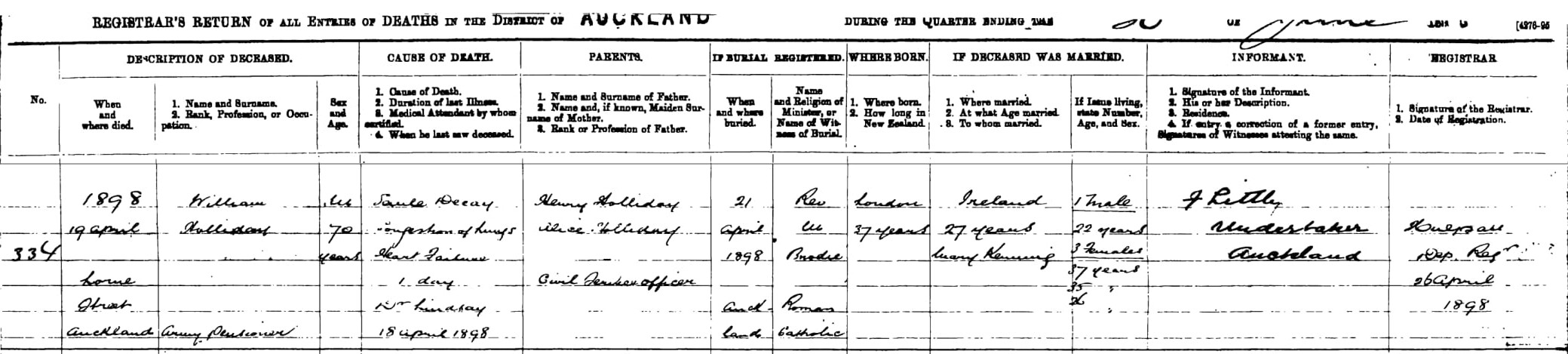
William was a Chelsea Pensioner and in 1897 he applied for an increase in pension which was granted and took his pension from 1s. 1/2p per day to 2s. per day due to the severity of the musket wound in his leg. William died in 1898 and was buried in Symonds St. Cemetery in Auckland. His grave site has been lost due to redevelopment of part the cemetery.
William's' Death Registration
Mary (Kemmy) Holliday (b. ~1835, d. 1901)
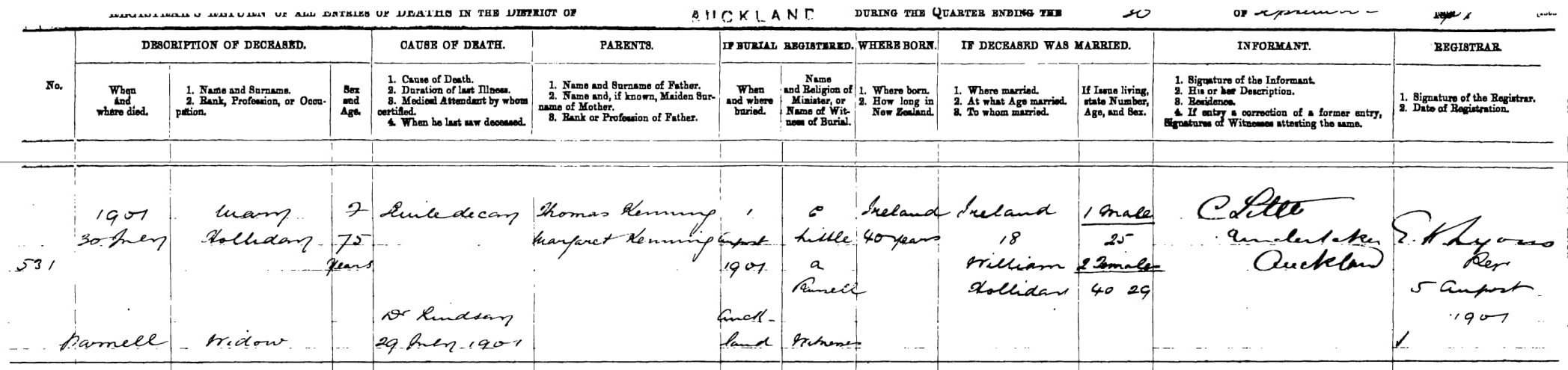
Mary Kemmy's birth date is uncertain. Her marriage registration gives her age as 21 when she was married in 1856, while her death registration gives her age as 75, which implies she was born in 1826. Her death registration also gives her age at the time she married as 18, which would imply she married in 1844 which is not correct. She may have been 18 at the time she married, and gave her age as 21 to avoid having to have a parent give consent. However, the marriage registration does provide solid evidence that the marriage took place in 1856, whether she was 18 or 21. So she was likely to have been born between 1835 and 1838 and so was between 63 and 66 at the time of her death. Mary died in 1901 and was buried in Symonds St. Cemetery in Auckland. Her grave site has been lost due to redevelopment of the area around the cemetery.
Mary's' Death Registration
Sarah Rosina (Holliday) Mudford (b. ~1861, d. 1937)
Mary Margaret Holliday (b. 1862, d. ~1900)
Mary was born in New Plymouth in 1862, which was where the 57'th Regiment was headquartered from mid-1861 onwards. Mary, along with her sisters Sarah and Alice, was commited to the Auckland Industrial Home in early 1872 for four years. The details of the story are outlined in Sarah's biography. After those reports Mary disappears from the public record. The only indication of her presence is that on William's death registration in 1898 he is shown as having three living daughters, the middle one of whom is the correct age for Mary. By the time of Mary (Kemmy) Holliday's death registration in 1901 there appear to be only two living daughters.
Alice Isabel Holliday (b. 1867, d. 1955)
Alice was likely born in early 1867, possibly in Auckland. This is based on the entry for William in the Married Establishment roll of July 1868 for the 2'nd Battalion, 18'th Regiment where the age of his youngest daughter is given as 1 year 4 months. At that time William was still in the 57'th Regiment and they were likley in Auckland as the 57'th had been recalled and was preparing to leave for Britain. William transferred to the 2/18'th Regiment on April 1, 1867.
Alice, along with her sisters Sarah and Mary, was commited to the Auckland Industrial Home in early 1872 for seven years. The details of the story are outlined in Sarah's biography. By the mid 1870's William and Mary were living in Thames, as William had joined the Thames Rifle Range Volunteers, so it is likely Alice grew up in Thames.
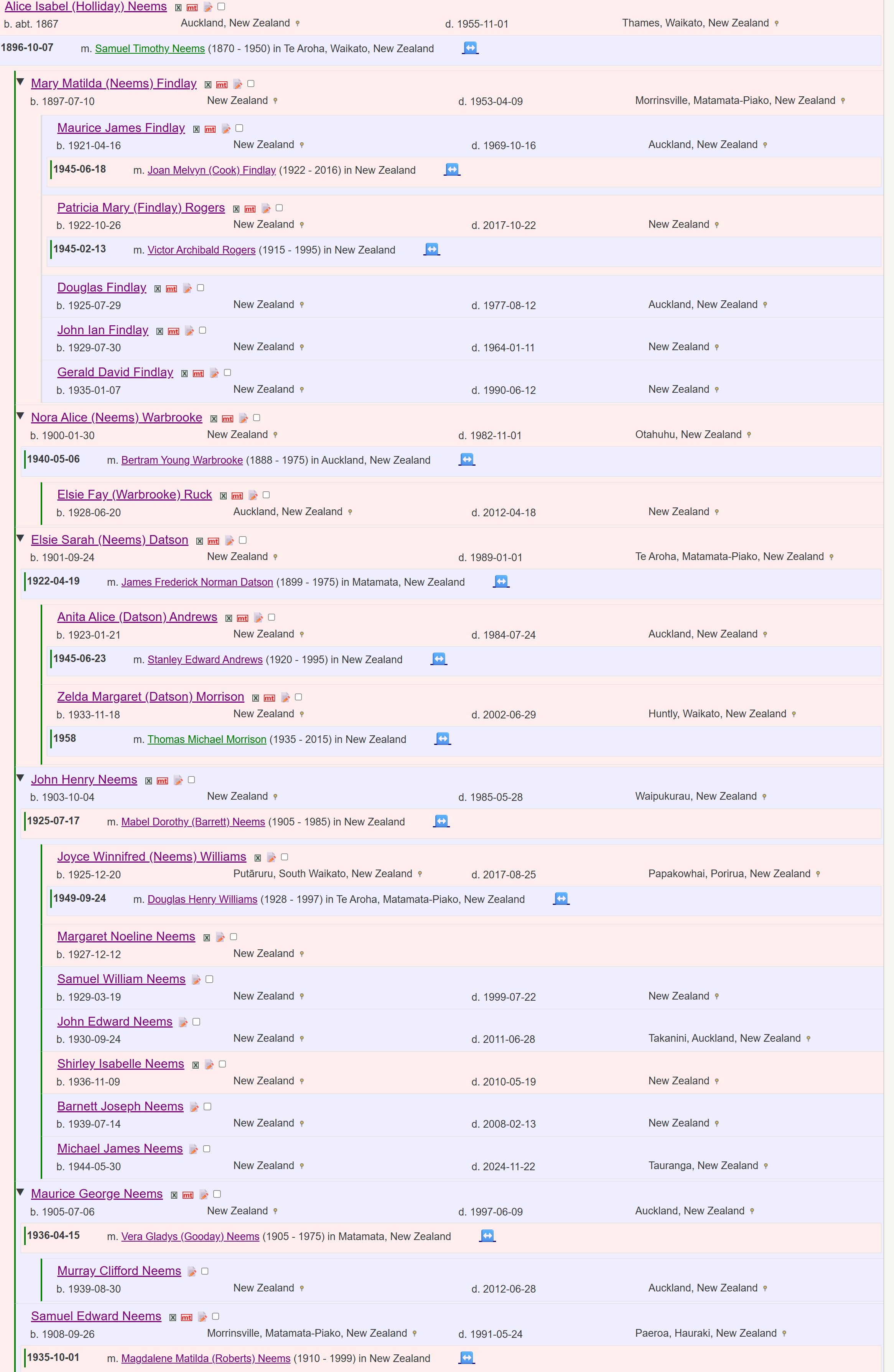
Alice married Samuel Neems on the 7'th October, 1896 at St. Joseph's Church in Te Aroha. She was given away by a Mr. M. Hotchin, and Gertrude Hotchin, presumeably his daughter, was her bridesmaid.
Alice and Samuel had six children who all survived to adulthood. They likely lived in the Morrinsville-Matamata area therir whole lives. Alice is buried in Totara Memorial Park in Thames, with her husband Samuel.
Alice (Holiday) Neems, b. 1867 WikiTree profile
James Holiday (b. 1871 d. 1871)
Alfred Holliday (b. 1875, d. 1944)
Alfred was born in 1875, in Thames. He served in the permanent force from 1896 to 1905. His personnel records can be accessed at the National Archives. However, due to their fragile nature the records can only be viewed in-house at the Wellington repository.
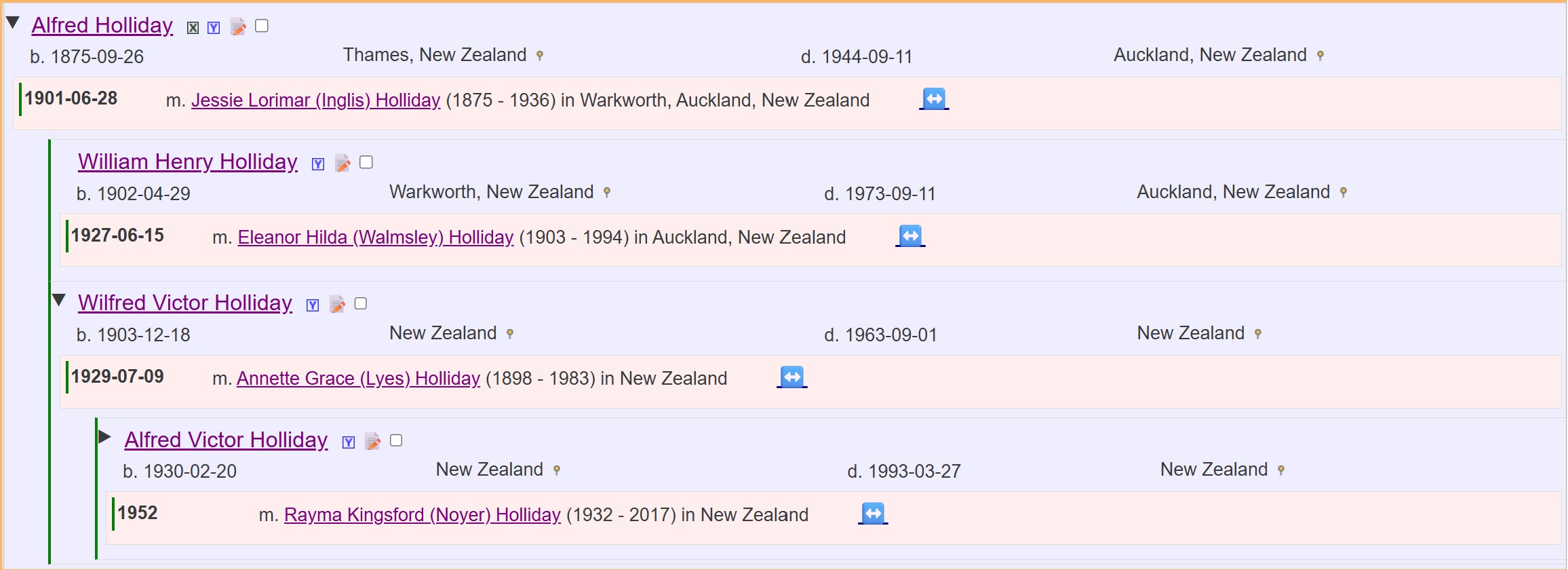
Alfred married Jessie Inglis on 25'th June, 1901 at the Warkworth Hotel which was owned by Jessie's uncle, Mr H. Kerr. They had two children William Henry Holliday, b. 1902 and Wilfred Victor Holliday, b. 1903.
After leaving the permanent force, Alfred leased the Warkworth Hotel from Jessie's uncle in 1911 and became the publican. They stayed in Warkworth until 1935, at which time Alfred retired and the moved to Mission Bay in Auckland. Jessie died in 1936 and is buried in Hillsborough Cemetery in Auckland. Alfred lived in Mission Bay until he died in 1944 and is also buried in Hillsborough Cemetery in a plot next to Jessie's.
Alfred Holliday, b. 1875 WikiTree profile